
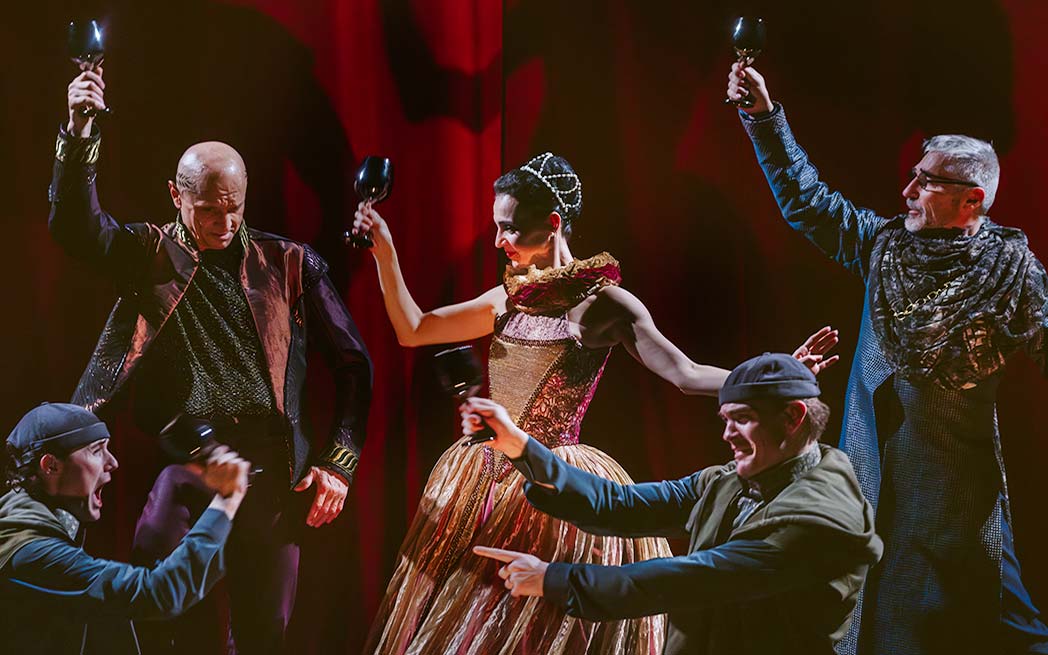
Hamlet reread in silence
through gesture and gaze
Movement reimagines a Shakespearean tragedy in a bold wordless creation
By Sophie Jama
May 14, 2026
We tend to associate major repertoire works with their words: finely honed dialogue, precise stage directions, texts we can read quietly at home while imagining how the actors move. Shakespeare, more than anyone, seems to belong to that family of authors we both read and watch. Here, however, the words withdraw and yield the entire stage to the body.
Guillaume Côté and Robert Lepage offer a Hamlet without spoken lines, but not without language.
Adapting a classic usually means condensing the text, shifting the action, and modernizing the setting, without completely breaking from the spoken word. Audiences recognize key lines and follow a familiar plot. But what remains of Hamlet when you dare strip the text away entirely and keep only the dramatic trajectory and its underlying tensions?
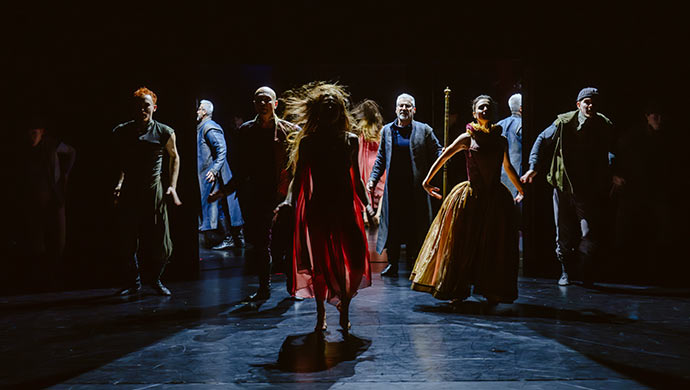
It took Robert Lepage’s theatrical imagination and Guillaume Côté’s choreographic writing to answer that question and to show that we can still “see” Shakespeare, even when his voice falls silent. In this danced version of Hamlet, Prince of Danemark, the story unfolds through a wordless language of movement, gaze, and an intensely engaged physical presence.
Scene after scene, the artists create living tableaux in which composition, lines of force, and the rhythm of entrances and exits serve as punctuation. At times, the stage seems to summon shared mental images – a collective memory of Shakespeare, re‑invented through movement.
A tragedy carried by dance
On stage, nine dancers move within a deliberately pared‑down environment. The restraint of the staging draws attention to the performers and to strong visual compositions: a compact group that suddenly breaks apart, a solitary figure standing centre stage, a face‑off that tightens like a zoom. Far from diminishing Shakespeare, this approach clarifies the story. The plot so many people think they know unfolds without rhetorical flourish, yet with sustained emotional intensity.
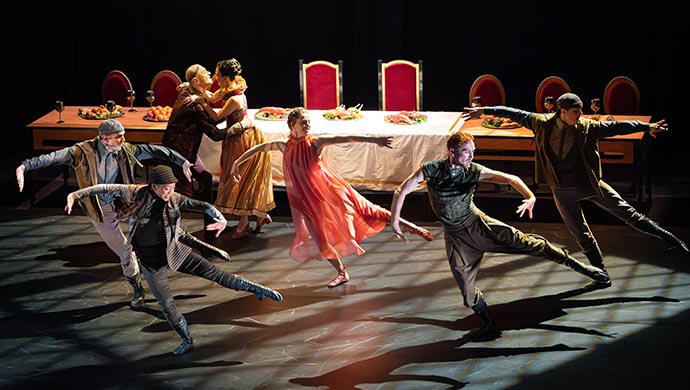
The creators are clearly counting on an audience that has at least some familiarity with Hamlet. Spectators arrive with scenes already in mind – the ghost, Ophelia’s madness, the final duel – and the choreography works from this shared foundation. It does not try to explain everything; instead, it rekindles a text already present in the collective imagination. In that sense, spectators become the silent guardians of the absent words.
Madness, revenge and lines of force
The central question remains: is Hamlet truly mad, or is he feigning madness to unmask his father’s killer, the uncle who has taken both the throne and the queen’s bed? The corruption of the kingdom emerges through physical tension, shifting alliances and confrontations that form and break apart. Bodies clash, evade one another, and at times freeze into almost painterly images, as if each pose revealed a particular state of power or consciousness.
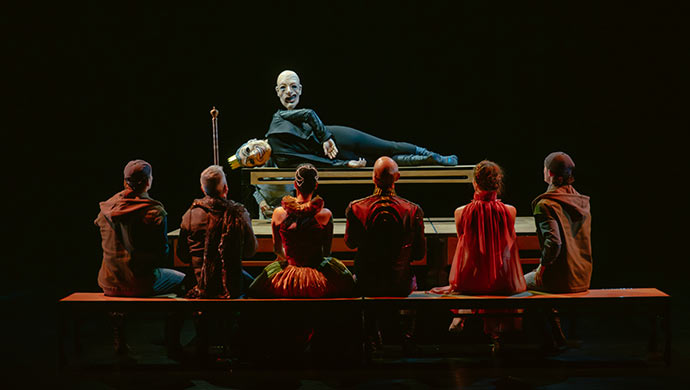
The dramatic progression stays faithful to the play: situations worsen until almost every character is gone, with Horatio left as the only survivor charged with remembering what has happened. In this version, the role is danced by a woman whose movement vocabulary, sometimes close to martial arts and sign language, becomes a kind of silent commentary. Without saying a word, she acts as witness and threads the scenes together like a continuous visual line.
A cast speaking through style
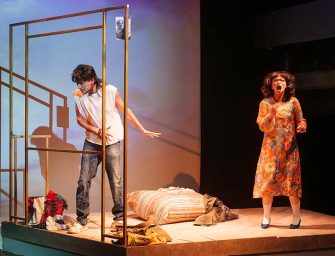
Each performer is called upon for their own strengths. Laertes, Ophelia’s brother, moves in a nervous, highly physical style shaped by street dance, which captures his impulsiveness and thirst for revenge. Ophelia, for her part, combines fragility and daring in choreography that flirts with acrobatics, as though her fate were constantly balanced on a tightrope.
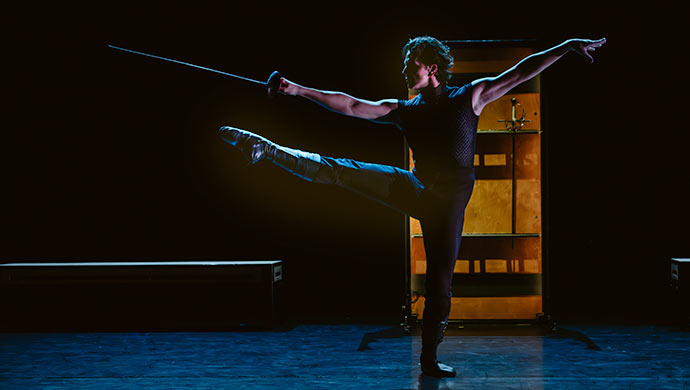
The almost twin figures of Rosencrantz and Guildenstern share an extremely synchronized movement language that underlines their function as an inseparable duo more than their individuality. Their duets can resemble offset mirrors, gestures nearly identical but slightly out of phase, producing a subtly unsettling effect. Hamlet, danced by Guillaume Côté, draws on the rigour and precision of classical ballet to make the character’s inner tension feel almost tangible. His solos, abrupt stillnesses and controlled falls build a series of images that tell of hesitation, revolt and despair.
‘Danced by Guillaume Côté, Hamlet draws on the rigour and precision of classical ballet to make the character’s inner tension feel almost tangible.’
In solo, in duet or in group scenes, the cast forms a coherent whole in which different styles answer one another within a clear structure. This diversity of movement languages becomes a way of illuminating the play’s many stakes, with each tableau highlighting a particular emotional tone or conflict.
Music, stage images and tragedy
John Gzowski’s original score accompanies the drama from beginning to end. It supports changes in tempo, underlines conflict, yet also leaves room for silence when needed. Rather than simply illustrating the action, it extends its impact, like an inner soundtrack to the tragedy.
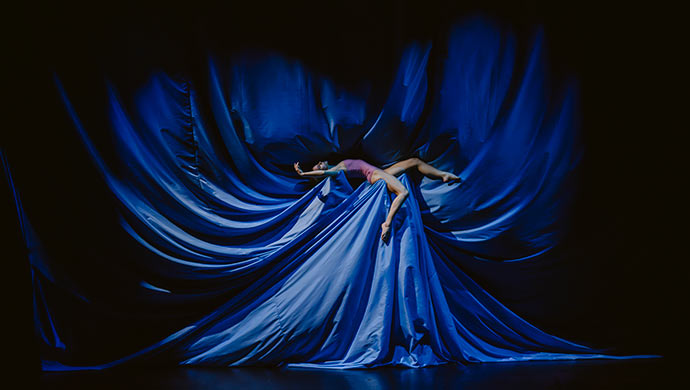
Several scenes stand out for their visual power. The ghost’s appearance, for example, seems to spill beyond the edges of the stage, as though the murdered king could not be contained. The “play‑within‑a‑play” is constructed through precise blocking and intersecting gazes, giving the impression of a theatrical device folding back on itself. Ophelia’s drowning, meanwhile, becomes an image of vertigo and surrender, with the body gradually tipping into a kind of choreographic flotation.
The costumes, designed with an elegant, contemporary touch, place the characters in a world that feels both accessible and slightly removed. They signal status, alliances and ruptures without anchoring the piece in a specific historical period. The tragedy thus takes on a timeless quality, free of historical reconstruction yet faithful to Shakespeare’s moral and political concerns.
An ending worthy of the tragedy
From his earliest entrances, Hamlet seems aware of the disaster that lies ahead. The final duel, a key moment in the play, brings each character’s trajectory to a clear conclusion. The confrontation, prepared throughout the performance, gathers together themes of revenge, guilt and loyalty. Shifting partners, sudden pauses and the way the music extends certain gestures all contribute to a last tableau of great intensity.
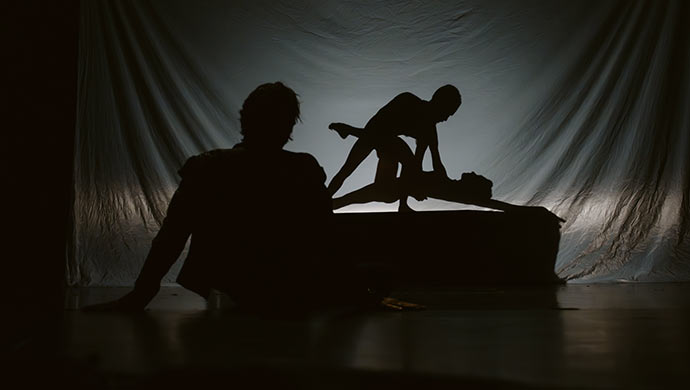
By the end, one has the feeling of having traversed the full tragedy without hearing a single line spoken. Words have receded, yet theatre remains fully present, carried by dance, music and precise direction. That is the core wager of this creation: showing that Hamlet can exist entirely through the art of movement without losing the force of its questions.
Hamlet, Prince of Danemark
Conceived and directed by Robert Lepage
Co‑conception and choreography by Guillaume Côté
Based on the work by William Shakespeare
Hamlet – Guillaume Côté, Kealan McLaughlin
Gertrude – Sonia Rodriguez, Greta Hodgkinson
Claudius – Robert Glumbek
Ophélie – Carleen Zouboules
Laërte – Lukas Malkowski
Horatio – Natasha Poon Woo
Polonius – Michel Faigaux
Rosencrantz – Jake Poloz, Connor Mitton
Guildenstern – Willem Sadler
Original music: John Gzowski
Lighting design: Simon Rossiter
Costume design: Michael Gianfrancesco, Monika Onoszko
Creative director: Steve Blanchet
Hamlet, Prince of Danemark
from May 13 to 23, 2026
Théâtre du Monument‑National
Images: © Stéphane Bourgeois
 Other reviews and critiques
Other recent articles

 May 15, 2026" />
 through gesture and gaze" />
 spring and summer" />
 is back for a new run!" />
 the Colorado Rockies" />
 Sherbrooke Street /1" />
 of decision-making" />
 Thai Lemongrass Soup" />
 its 2026-2027 season" />
 Investing with life insurance" />
 Stories and emotions" />
 Gentle speech as resistance" />
 strengthen their partnership" />
 Peanut Butter Dog Treats" />
 the ideal job candidate" />
 Costa Rica’s simpler living" />
 sings Orlando di Lasso" />
 for all seasons" />
 to master an art" />
 a play set in Westmount" />
 hen with preserved lemons" />
 facing new managers" />